Social Media As a Learning Medium For Students
January 22, 2022 2022-01-22 0:00Social Media As a Learning Medium For Students
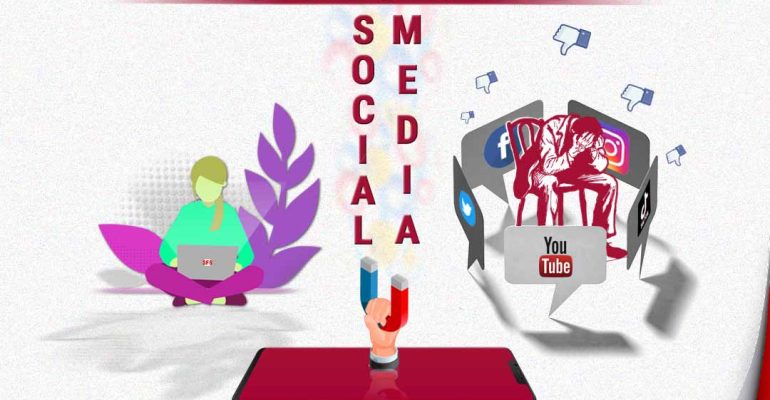
Social media in the present time has become a very indispensable part of our life. With the emergence of digital technology around human lives, life has become easier yet complicated at times.
Nowadays one can not imagine even a day without scrolling through social networking sites and checking for different information on the internet.
It is very common nowadays for teenagers to have a social media account on any of the many platforms available to them. According to reports, more than 60% of teenagers have social media accounts in the present time. And it is undeniable that most of them are students who use different websites and apps for different purposes.
However, the biggest question that arises is can social media positively influence students and education as a whole?
The answer to this question will be a YES if the popularity and passion for social media can be used as an advantage in the education of the students if the platform is used rightfully.
There is several ways where social media can be used directly in the classroom for the benefit of the students. If we opt for social media as a tool for education, it can be advantageous to all from elementary through college.
1. Using Facebook for Updates and Alerts
Facebook or Meta as it is now known can work as a perfect social media platform to be incorporated into the classroom. Rather than trying out the traditional methods of learning for every little thing, new technologies and tools can be used to keep the engagement intact. Sticking to something quite familiar and widely used among all is always the best choice. Create a Facebook page for the class updates, alerts and notifications. Moreover, assignments and online group discussions can also be encouraged through the Facebook page. The best part is that these pages are accessible even if the students aren't active on Facebook. However, we must remember that Facebook is a public platform and anyone can comment or react to it.
2. Facebook Group for live-streaming of lectures and discussions.
Covid-19 has taught us very well how technology and digital media can be hugely advantageous. With the new normal adopted by the people, instructors can create Facebook Groups for each of their classes and host discussions on several topics. Facebook Live lectures can also be hosted with resource persons or professionals joining the session. These kinds of lectures and discussions will keep students engaged during school breaks, holidays or pandemic situations. Additionally, it is extremely important to ensure a professional boundary while setting up a Facebook Group which is why instructors and teachers must always look into the decorum of the Facebook Group. These ideas can make it very easy to connect students and teachers for learning.
3. Instagram for photo essays.
Nowadays visual presentation plays a very important role in the professional field. So the practice to use it can start early by creating photo essays on Instagram. Field assignments can be presented as a series of photos or graphics in a visually appealing manner.
It was so great that we have a social media platform such as Instagram that allows students to practice digital storytelling. Students can always create personal accounts based on their subject and project and can delete them later when the course is completed.
4. Twitter as a class message board.
We have this wrong notion that Twitter cannot be used as swiftly as Instagram or Facebook in terms of Education. However, that's not true. Because Twitter can be of great use as a message board or discussion board for a class. Instructors and teachers can create a single account per class and use it every day. The queries of the students can be precise and up to the point due to the 280 word limit on Twitter which will not allow unnecessary questioning and help communicate concisely and effectively. Teachers and instructors can also create discussions and Twitter chats surrounding a specific hashtag that they create for the class only.
5. Assign blog posts as essays.
To make social media and learning a fun experience for the students, instructors can help students create their blogs for essays and other write-ups. This is a very interesting strategy that can enhance the writing skills of the students as well as encourage them to use digital media in a much more effective way. Blogs given as assignments for the students can improve writing abilities and critical thinking. However, this idea must not be adopted only for English or writing classes. It can be used for all the subjects.
Other Benefits of Social Media that Can Produce Better Academic Results for Students.
1. Finding information for education in Social Media
Social media websites contain an abundance of different information with millions of links to other resources depending on different topics and subject matter. All it needs is an eye for it to search the adequate information. That means that apart from games and music students can find answers to unsolved questions and queries. Some sites offer groups by interest while others contain the latest data and survey results on a variety of topics and research on the subject matter. Many students in our society desire to study abroad and look for opportunities to fulfil their dreams. Social media can connect students to such institutions that offer much useful information on students programs and grants. Moreover, connecting with other students from different countries can help students know about the cost of living or studying personally through messages.
2. Attention to written text and reading
Another positive side of using social networks in education is a desire to read and write without any obligations. Usually, young students do not enjoy reading or writing text and parents or teachers have to force them to do so. But the best part is that using smartphones or tablets and assessing messages, news, comments, articles and much other information on the website pages can be endless and make students get ready to devote their time and learn all that without putting in much effort. This can be considered as a contribution to the overall level of intelligence as well as improves writing and reading skills among the students along with making the learning experience more fun and engaging.
3. Distance learning opportunities
Modern educators look for new approaches to attracting students to various courses and areas of study. Distance learning and integration of social media is one of those new approaches that these modern educators look for. Reports say that according to MOOCs early data learning programs with integrated social media platforms are better visited and less often dropped out than other ones. There is even a recommendation for colleges and universities to make use of this positive phenomenon. Many institutions in Assam have already started adding this to their study programmes.
When you see it, it is hardly so that there is anything common between education and social media. But opportunities can come from anywhere. It just needs the right mind and eyes to find it. It is still a universal fact that Education takes place better in a classroom with the physical presence of students and educators. But with the changes of time and coming of new technologies, education has also gained various new features and also updating. Social media is the greatest technology that impacts it today. It opens the door to unlimited access to knowledge and skill development that many of us still find new. Social media can be of huge advantage if used effectively for productive results.