
ARE WE RAISING PROBLEM-SOLVERS OR ANSWER-SEEKERS?
August 29, 2026 2026-08-29 10:42ARE WE RAISING PROBLEM-SOLVERS OR ANSWER-SEEKERS?
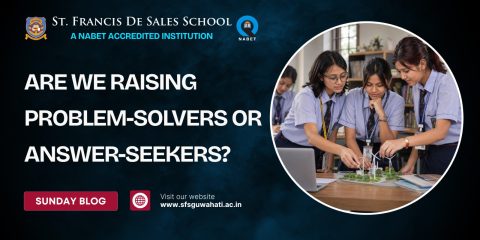
A child asks a question.
Before they have finished asking it, someone reaches for a phone.
Within seconds, the answer appears.
This has become a familiar part of everyday life. Information is everywhere, answers are increasingly accessible, and technology can help us find, explain and even create things almost instantly. But in a world where answers are only a few clicks away, an important question arises:
Are we teaching children to find answers or teaching them to solve problems?
The difference matters.
The Age of Instant Answers
Today's children are growing up surrounded by technology. Search engines, educational platforms, artificial intelligence and digital resources can provide information faster than ever before. This is undoubtedly valuable. Technology can make learning more accessible, personalised and engaging.
But easy access to information also creates a new responsibility.
When a child encounters a difficult question, do they immediately search for the answer or do they first pause, think, make connections and attempt to work it out?
The goal is not to prevent children from using technology. The goal is to ensure that technology remains a tool for thinking, rather than a replacement for thinking.
A Question Can Be More Valuable Than an Answer
A good learner does not simply ask, “What is the answer?”
They also ask:
Why?
How do we know?
What if...?
Could there be another way?
What would happen if we changed one thing?
These questions encourage children to investigate rather than simply receive information.
A child who asks why a plant is not growing is already beginning a process of observation and problem-solving. A student who wonders why one solution to a mathematics problem works differently from another is developing analytical thinking. A child who questions whether everything they see online is true is developing digital literacy.
Curiosity is often the beginning of problem-solving.
Let Children Struggle a Little
As adults, we naturally want to make things easier for children. When they are stuck, we are tempted to give them the answer.
But sometimes, a little productive struggle is exactly what learning requires.
Instead of immediately saying, “Here is how you do it,” we can ask:
“What have you tried?”
“What do you think might work?”
“Is there another way you could approach it?”
This does not mean leaving children frustrated without support. It means giving them enough space to attempt, rethink, make mistakes and try again.
The satisfaction of discovering a solution independently can build something that a correct answer alone cannot: confidence in one's own ability to think.
The Classroom as a Problem-Solving Space
A classroom should not only be a place where students receive information. It should be a place where they explore ideas, test possibilities, collaborate, question assumptions and find solutions. Projects, experiments, discussions, real-world situations, puzzles, collaborative tasks and open-ended questions can help children understand that problems do not always have one obvious answer.
Sometimes the process matters more than the final result.
A student who learns to approach an unfamiliar problem calmly and systematically is developing a skill that will remain valuable far beyond school.
What About Artificial Intelligence?
The rise of Artificial Intelligence makes this conversation even more important.
AI can generate explanations, summarise information, suggest ideas and produce answers. As these tools become increasingly capable, knowing how to use them responsibly will be an important skill.
But students must also learn to question what they receive.
Is the information accurate?
Does the explanation make sense?
What evidence supports it?
Is there another perspective?
Can I explain this in my own words?
The future will not simply belong to those who can access information fastest.
It will increasingly belong to those who can evaluate information, ask meaningful questions and make thoughtful decisions.
Parents Can Build Problem-Solvers at Home
Problem-solving begins with everyday experiences. Instead of immediately solving a child's problems, encourage them to think, make choices and explore possible solutions.
Let children plan, compare, decide and learn from mistakes. Ask not only “What is the answer?” but “How can you figure it out?”
The Real Goal of Education
The future will bring challenges we cannot always predict. What children need, therefore, is not just information, but the ability to question, adapt, think critically and find solutions.
Education must go beyond creating answer-seekers. It must nurture thinkers, problem-solvers and curious minds who can confidently say:
“I don't know yet, but I can find out.”
At St. Francis De Sales School, Guwahati, we strive to nurture curious, confident and independent learners through inquiry, experiential learning and opportunities to think creatively.
Because true learning is not about having every answer, it is about knowing how to find one.