
PERSONAL SPACE: RESPECTING BOUNDARIES
April 15, 2023 2023-04-15 0:00PERSONAL SPACE: RESPECTING BOUNDARIES
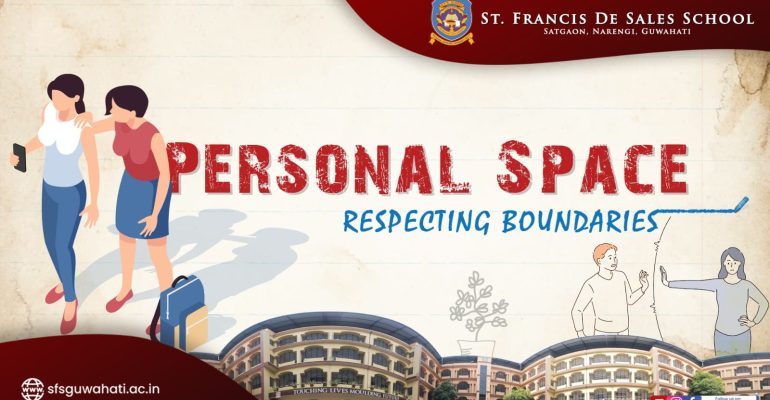
Hi, young people!
The other day we had guests at our place. A man in his fifties, his wife, and his mother — had come for dinner. I met them for the first time — they’re my parents’ acquaintances. But I found it really awkward when the man, while going to the dining room, stopped in my room on way and started examining some of my medicines kept on a table and began asking all sorts of unwarranted questions like “Whose medicines are these?” “What are these for?” “What is the nature of your illness?” etc. I found it awkward because he invaded into my personal space, asked all sorts of things that were totally unnecessary, and gave advice that was unasked for. Had he been a doctor, I would have still understood. Moreover, he was a stranger to me. I had met him for the first time and this kind of probing was totally unexpected!
You might be wondering why I’m sharing this with you. The reason is simple. I want you to understand the idea of personal space and learn to respect boundaries from now on so that when you become an adult, you don’t make anybody feel uncomfortable the way this 50-something-year-old man made me. Maybe, as a child, he was never taught about these boundaries. Learning these things will ultimately help you become an empathetic individual who knows where to draw the line while visiting someone’s place, going out, or even in school or at one’s place. No matter how intelligent or smart you are, people notice what you ask, how you interact, etc., in public and in private.
First of all, let’s understand what personal space is. The Merriam-Webster Dictionary defines personal space as “the distance from another person at which one feels comfortable when talking to or being next to that other person”. That means whenever you’re interacting with someone, you have to make sure you’re not sitting/standing too close to the person, making him/her uncomfortable. It also implies when you visit someone’s private space (someone’s house), you behave/talk in a manner that doesn’t make them feel uncomfortable. And it’s not just about private space — you should also ensure you do not ask/say things that can make people uneasy.
Here are a few helpful tips to ensure you do not make others uncomfortable around you:
-
When you visit someone’s place, do not touch their things or go through their personal belongings. If you really want to see something — for example, a book or a toy, please do so only with the host’s permission. Please understand that their home is their private space and you have no right to examine their things without their permission. Also, be careful about things you ask permission for — for example, you cannot go through your friend’s mother’s wardrobe or her clothes or make-up. That would be really unacceptable.
-
Please avoid asking personal questions when you visit someone. If you are introduced to adults, do not ask them about their marital status, the amount of money they are earning, or how many children they have. Even with your friends, you should draw the line and not ask things like “How many cars do you have at home?” or “Do your parents fight?” If your friend wants to share family problems, he/she will anyway do and then you can offer support or ask him/her to see the school counsellor.
-
While visiting someone, please do not pass negative remarks about the food offered by them. If the host has taken out the time and effort to cook/buy and serve you food, that itself is a nice gesture, so be grateful instead of complaining. But if you like the food, you can definitely compliment the host.
-
Please ask for permission if you want to use the washroom at someone’s house. Do not barge into their washroom or bedroom, unannounced. Also, give privacy to others if they’re using the washroom — be it at school or at home. There’s no need to knock repeatedly. You can use the next available washroom or just wait for some time.
-
Do not eavesdrop on people’s face-to-face conversations or phone calls, be it at someone else’s place or at your place. You have no right to listen to other people’s personal conversations. Also, you should not read other people’s diaries, emails, WhatsApp texts, etc. even if it’s open right in front of you or if you realise there’s no password in their laptop/phone or any other device.
I hope these tips will help you gain insight on how to respect the personal space of others and, in turn, also get your space because when others see you respecting their space, they’ll automatically start respecting your personal space too.