
MAY DAY: HISTORY AND SIGNIFICANCE
April 30, 2023 2023-04-30 0:00MAY DAY: HISTORY AND SIGNIFICANCE
Hi, young friends!
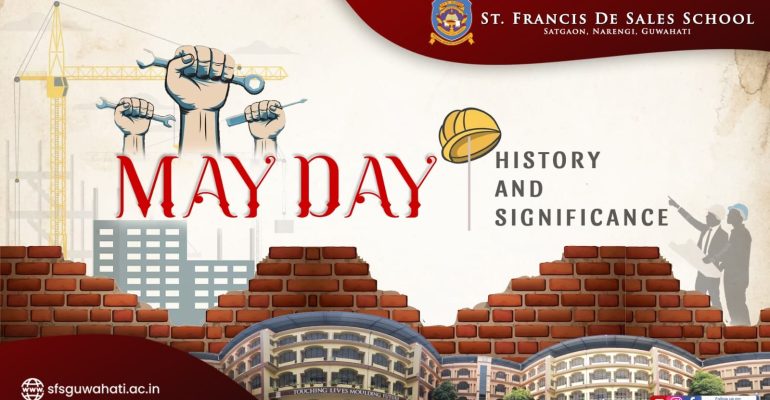
Do you know that Gandhi ji used to clean toilets if he reached before time to attend meetings during India’s freedom struggle? He believed in dignity of labour and the fact that no work is inferior or superior. All work is equal. I’m saying this because tomorrow is a significant day. It's May Day. Also called Workers’ Day or International Workers’ Day, it honours the struggles of workers and the labour movement. May Day is observed in many countries on May 1.
It’s important to know about this day so that we start respecting every worker and start believing in dignity of labour. Remember, children, no work is small or big. The plumber who repairs your taps or the sweeper who cleans your surroundings or the factory worker who packages your favourite snack — they all deserve to be treated with respect. Do not ever mistreat or look down upon people because of the work they do.
Now let’s know a bit about the history behind May Day:
The roots of May Day can be traced back to the second part of the 19th century when industrial workers demanded for reducing work hours from 12-15 hours a day to eight hours in countries such as Germany, France, England, and the US. The Communist Manifesto written by Karl Marx and Engels in 1848 also impacted workers worldwide.
Moreover, crop failure in the 1840s led to anti-feudal protests called ‘The Revolutions of 1848’. So, the International Workingmen’s Association, known as the First International, was born in 1864 at a workers’ meet in London. However, the First International dissolved in 1876 over an ideological difference.
The Haymarket massacre can be considered a major event leading to the origin of May Day. On May 4, 1886, when labourers assembled at the Haymarket Square in Chicago and took out a rally for an eight-hour work day, there was a bombing attack on them. Police firing and loss of 11 lives were reported at the rally which ended in riot.
Then the Second International emerged in 1889 and it chose May 1 as a day in support of workers, declaring it as International Workers’ Day. Five years later, US President Grover Cleveland signed a legislation to make Labour Day the official US holiday in honour of workers.
In the Soviet Union, leaders embraced the new holiday, as they believed it would encourage workers in Europe and the United States to unite against capitalism. In Germany, Labour Day became an official holiday in 1933 after the rise of the Nazi Party. But Germany abolished free unions a day after establishing the holiday, thereby ending the German labour movement.
Let’s know a bit about May Day in India:
India first celebrated Labour Day in 1923 in Madras (now Chennai). Meetings were held under the aegis of Singaravelar, leader of the Labour Kisan Party of Hindustan, and a resolution was passed, urging the British government to declare May 1 as Labour Day and also a government holiday. It was the first occasion in India on which the red flag was used.
Since then May Day has been celebrated in India on May 1 every year.
Significance of May Day:
The purpose of celebrating Labour Day is to honour the enormous effort put in by the working class, to inform them of their rights, and to safeguard them against exploitation.
Hence it’s very important to know these things and stay alert even when we employ people to work for us. For example, we cannot employ children below the age of 14 in our homes, shops, etc. as it would tantamount to child labour, which is illegal in our country. If you see anyone around you doing that, you should immediately inform your parents/teachers/caregivers.
Stay alert and treat everyone with dignity!